Saturday, June 14, 2008

13 de Junio


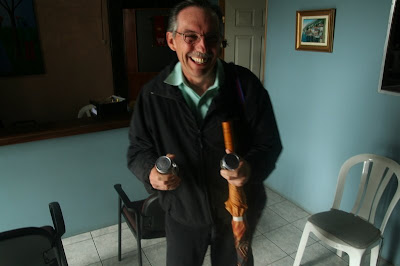
a local taking a break from the festivities in San Antonio


So I`ve been praising the joys and comforts of time off in Panajachel, but I have found that Catarinecos are not without pleasures of their own.

Last night, after a dinner of big blue grilled mushrooms with tomato sauce and tortillas, we got in the temascal. Wearing only my scivvies, I crawled into the four-foot-high brick chamber after Luis and sat on the bench next to him. Except for the glowing embers, I could see nothing. First Luis handed me some kind of good-smelling tree branch, and we patted ourselves with these while he periodically poured water onto hot stones over the embers, making the air thick with steam like a sauna. Then we scratched ourselves all over, you know, to get the dead skin off. Then he drew water out of a cauldron heated by the fire, and we bathed ourselves with this and with soap. From then on it was just like a hot bath sitting on a bench, all steamy and aromatic. “Ah, it's rico, huh?” Luis said a few times. Rico literally means rich, but it's usually used for food, something like delicious, “bien rico,” or like Puerto Rico (“Rich Port”). A temascal is definitely that.

Afterwards, Wilson and Catarina insisted that I rest. It's best to sleep, they said, but to avoid being sick, I should lie down for about ten minutes because the temascal is very hot. It's makes Catarina's head hurt. Either way, it felt really nice with my skin smelling clean with a trace of the sweet incense smell of the firewood.

Luis came into my room and sat down and asked me if my head was okay. I said that it was fine, but he twirled his finger around his head making the loco sign and told me that he felt a little crazy because of the heat. He smiled and laughed some more. “You have anything like this in the United States?” I described to him a sauna, which is in fact very similar, and I told him that I thought those originated in Europe and that they are usually public, not personal. “Ahh, it's so nice, very good for you” he said. “It's like medicine.” He says we'll do it again in ten days.

I want to interject here the fact that Catarina works very hard. She prepares fires for cooking before every meal she makes, which is two to three per day. Last night, she crawled into the temascal to prepare the ashes, unphased by the smoke. Tonight she burnt her hand and sent Wilson to ask me for a bandaid, which doesn't surprise me given that she flips every tortilla by hand and carries the coffee pot with her bare hands when the boys hesitate to touch it.

For dinner we each had a bowl of beans (like kidney beans) with a hard-boiled egg sitting in it. And tortillas and coffee. I would call this meal exactly average, a good indication as to what I'm eating down here. I have lost weight; Dr Wallace commented on this the other day, and the temascal photo might indicate this. Nonetheless, I still feel totally healthy, Mom, even though I do look forward to eating when I get back. (She knows this. We email.)

Sometimes after dinner I go down to the campo with the boys and maybe some of their friends and we play soccer and basketball. It's hard to see, which is part of the fun. I think I should look for a glow-in-the-dark all-purpose ball to get for them as a going-away gift.

Something else. My Spanish has had a huge spike over the last week or so. I've suddenly realized that I rarely feel limited by the language anymore when I speak with my family; I can explain anything I need to or make a joke when I want without thinking about it. After about a month, you become comfortable with a certain word bank and you get used to the way people talk. The most trouble I've had recently was explaining to Luis that I didn't want Catarina to go to the trouble of washing a pair of pants that I had forgotten to give her unless she was already going to wash a load of other clothes as well. After three or four tries, I got the idea across. I guess that's kind of a complex situation. That was maybe five days ago, and thinking about it now, I'd probably have an easier time saying it now than even then.

This morning Luis and the boys and I went to San Antonio's town festival, one town over. It was great for photos. There were more convites, those dancers in the crazy costumes; I have pictures this time. Afterwards, Luis told me that he thought the convites were much better at Santa Catarina's festival. He said it was because they danced better.

I'm continuing my reading binge. I'm kind of on a classics/literature thing right now because I feel like there are a lot of staples that I haven't read, especially being that I'm a literature major, so I read Animal Farm. As a novel, it's okay. The writing is kind of boring, but then again, it's supposed to be a kind of fairy tale, with flat characters and such. The story is good, and it's best if you're into the whole historical context of it, which I know about an average amount about, and this makes the preface and the introduction the most interesting parts. To read today, it's a fun way to get an idea about what happened to communism, which is why it's on junior high reading lists. I'm unenthusiastic about it; I guess Hemingway spoiled me. I really loved For Whom the Bell Tolls. Zach brought The Shining with him and highly recommends it, so I think I will read that next. Stephen King is supposed to be a great writer, so that'll be cool.

This is, by the way, the most consecutive pleasure reading I have done in my entire life. It's always school, and then in the summers it was always summer reading, and then in my spare time I always run to some other kind of stimulation. Here, there are fewer distractions.

As far as my project, I think I'm about on track, although all this talk of pleasure reading makes me feel as though I'm behind. I've been watching things around town a lot, and I always read in at least a semi-public place, which is a solid way for people to get comfortable around me in such a small town and for me to passively observe things. Yesterday, for example, I was just reading in Luis's galeria while he and this really old local guy chatted about something in Kaqchikel. Eventually they must have started talking about me because Luis addressed me in Spanish. We all talked for a bit, and the conversation turned towards languages, and then it turned into a Kaqchikel lesson for me. The old man seemed very eager to teach me Kaqchikel and taught me eye, ear, tooth, hand, nose, and bread. He may come by tomorrow, and I may have another lesson, and I may ask him his name and what he does, etc. The next time, I'll ask him if I can interview him about dogs.

Sitting in Luis's galeria, I run into many more tourists too. Some days there are no groups of tourists, some days there are five or six. Maybe 60% of the tourists that stop by speak English. The most popular are the young backpackers, either large groups of girls, a group of two or three guys, or a couple. The couples never talk to me. My favorites are always the families, I guess because it takes a somewhat entertaining family to travel together. There are the Spanish-speaking families with the women wearing tight, tight pants and usually curly hair-dos, the reserved father with slick hair, the quiet teenager who doesn't want to be there, and the talkative and whiny little kid.

I especially liked one family: a brown-eyed, olive-skinned, bilingual bunch from Florida, originally from Cuba, who talked like they were from New York. They stopped by Luis's on one day and then I ran into them in Panajachel on the next. In order from most to least talkative: the mom's brother who seems sly and slick but interrupts to make a good joke and asks good questions, the mom who would perfectly fit the role of the mom in a family-based sitcom (Home Improvement, Raymond) if you cut her talking speed in half, the late-teens daughter who was just like her mom, the good-natured dad with thin sweaty curly hair, the early-teens boy whiz-kid with glasses, and the aloof late teens-boy with a baseball jersey and basketball shoes. The dad was always like, “Yeah we checked out those ruins too, hey Ronny (whiz kid) what was the name of those ruins?” And then “No last night, last night we stayed over at that town across the lake, hey Ronny what was the name of that town we stayed at last night across the lake?” The dad and the uncle smoke cigarettes together.

Another piece of conversation from them:
“Ohh I really like this painting how much is this?”
“No honey we don't have enough on us right now. We're coming back here tomorrow remember so we can get some more cash from the ATM.”
“No but if I don't buy it now then I won't buy it. We have enough look I've got five-hundred qet-salls right here.”
“No mom remember we still have to pay this guy!” The daughter pointed to a short man in a collared shirt standing in the middle of them who had not said a word and whom I had not noticed at all until then.

Today there were missionaries from Nova Scotia, a handful of men in button-downs and dark pants and shiny shoes who talked to me with welcoming faces. There were one or two women in long, canvassy skirts. We witnessed a short dog fight, and I told them about my project. After bidding me farewell, the leader of the bunch left me with, “Don't let your life go to the dogs. Give it to the Lord Jesus instead.”

Honestly, I have an easy topic. Some students have to seek out certain populations: Sarah has to hunt for families who have been divided by religious conflict, Nicole has to find people who control access to computers. For me, if you live in Santa Catarina, then you know about the dogs. My only problem is finding people willing to have an interview; I have been politely or cleverly turned down more than a few times. It's better if it's someone who at least knows who I am, like the lady at the internet cafe or the bread guy. If not that, then it's good to have an intermediary, which is where Wilson comes in, because he knows a lot of families. Basically, I have no excuse for a shortage of interviews.

In other news... I mentioned in passing at one point that Valerie was sick. She actually had appendicitis and had an operation done down here. Her mom flew down to be with her through the operation, and afterwards they hung out in Panajachel while she recovered. They've since decided it would be best for her to go back home. Best of luck recovering, Valerie. We'll miss you.

To end on a less somber note, it's worth mentioning again how gorgeous Santa Catarina is. Walking back into town from the beach area, I am overcome by the sheer steepness of the mountain wall that holds the pueblo. It's similar to the feeling you get when you stand at the entrance of a skyscraper and look up to the top of it and feel as if you're going to fall over backwards. And what's more, the slope is grassy like a meadow and speckled with trees that grow out of the face at a slanted angle, so that if you concentrate on only this section of it and then suddenly consider the whole view, it throws off your vertical perspective, like a cubist painting.
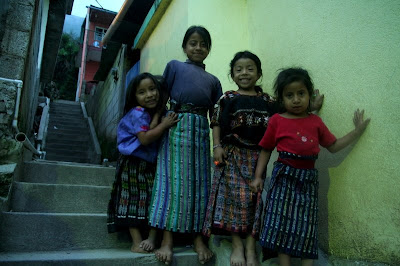
``Una fota?`` one of them asked, and another told her, ``It`s foto, idiot.`` It`s a good deal for me because all they want is to see themselves on the screen afterwards.

in Santa Catarina

L to R: temascal, me. It`s very short.

San Antonio, on the way to the festival


L to R: local who apparently thinks he is San Antonio, San Antonio


some convites taking a break from dancing


Luis chases away some perros from his tienda. They had been fighting.


Thursday, June 12, 2008

11 de Junio


Que pasa: Notice that the titles of these entries are the day that I write them, not the day that I post them. So there's a little lag in what I'm actually thinking/doing because of my internet access, or lack thereof.


Thanks to those of my family who gave encouragement after my last entry. Know that I am a long way from despairing. All that's up is that I'm having to take little measures (coffee, peanut butter, a novel in English) to keep my bearings, something I've never really had to do before. It seems weird to me because I'm not like a prisoner or anything, so I hesitate to embrace a “you can make it” mentality. I have chosen to do this myself in order to see if I like ethnographic fieldwork, a 24/7 thing that swings with your mood. Overall, it is stretching me and humbling me, two things that must be ultimately good.


I have spent much of the last two days sitting in a chair at the entrance of Luis's gallery, reading. I have finished For Whom the Bell Tolls, and it was an excellent read. I'm going to get another book tomorrow in Panajachel. If you know me, you know that I'm a slow reader (getting faster), so that tells you how much time I have spent reading.


I love Hemingway's style because it really gets into the characters' heads. He follows their trains of thought and saves his most descriptive language for their memories and impressions. All 470 pages take place in the span of 3 days, so you can imagine how much detail there is. A great sentence: “His face looked as though it were modeled from the waste material you find under the claws of a very old lion.”


The old paperback book broke in half because I used it to swat flies, which means I can't sell it back to the bookstore for half the price of 40 Quetzales. I killed many flies though.


Something else about the book: the main character is Robert Jordan, an American ex-pat fighting in the Spanish Civil War, so the dialog is transliterated from Spanish. Towards the beginning of the book, one guy says to him, “So much talking makes me very thirsty, Comrade Hordan. You have a funny name in Spanish, Comrade Hordown.” Funny because the day before I read this I had had a conversation with Luis about saying Jordan. It's very hard for Spanish-speakers to say the j sound; the closest equivalent is ch. I have been helping Luis practice his English. “Whesch pintin do you like?” “Whesch pants do you like?” “Orichinal work” “Tree-handred dollars.” He wants to learn to say sure, but I think it would be best to leave that one alone because it doesn't come out any better than “chird.”


But sitting at the same spot along the main road of Sta. Catarina for two days straight has also been good for giving me a feel for the rhythm of this town. Luis and I chat some, and he has his own greetings for each passerby. In this town of 3000, he has sat at this same spot every day for I don't know how many years, so he knows about everybody. He taught me some Kaqchikel greetings today, which are many and vary with the time of day and the age and sex of whom you are greeting.


Also what's neat about this town are the noises. It's small enough that you could hear faintly someone scream from one side to the other, although the noise of the town would obscure it. Someone is always blasting music in the morning or the dogs are always barking at night, and then there are the sounds of the day in between. Every kind of service vehicle has its own distinct noise to announce his presence. The man with the ice-cream cart has jingle-bells that he shakes. The bread man has one of those old-school brass horns with the rubber squeeze-ball (and he comes along our stretch of town every day around 2:20 with fresh banana bread, cinnamon bread, sweet bread, and other kinds, all 1 Quetzal (about 14 cents) a piece. They are baked individually in rolls, not loaves, and I buy one every day). The pickups have their quick police siren noises. The buses have their barge-horns. The promo-trucks for Coca-Cola or Gallo or the cell-phone companies blast music and muffled announcements of deals out of the loudspeakers on their cars. That leaves the car alarm for the garbage truck (you know, that 8-phase car alarm).


It's amazing how my attitude towards the food here has developed: I have loved it and hated it, I have praised Catarina for it sometimes and I have eaten in silent disgust other times. Granted, some dishes are better than others, but some things (tortillas) never change. I haven't mentioned this yet, but my amoebas are gone, so the ol' digestive system is back on track. I'll say now that my sickness affected my appetite way more than I realized at the time, and now my attitude towards the food has come about full circle.


Today (and yesterday) for lunch we sat in the back of Luis' gallery and ate hot tortillas and processed packaged ham and lukewarm coffee. Not much of a meal, but I have grown to look forward to even that, as long as the tortillas are hot. I have run the whole spectrum of getting sick of things to having things grow on me. There is no telling which way it will go next, or when it will level out. I wonder how much of my appetite has to do with the novelty of the food and how much to my natural disposition to it.


On its erratic and uncontrollable track, my attitude towards food here develops just as much as (and probably affects) my attitude towards the people and towards this place in general.


Funny: as I am writing this Catarina knocks on my door with a hearty “buenas noches” and brings me something she bought below: a tortilla with black beans cooked inside, called ta' un. She made these a few nights ago herself; I picked one up and was fascinated. They're really tasty. I have asked if I could learn how to do this. She says it is difficult but she will teach me.


I've been making tortillas with Catarina before dinner. I'm getting better. I found out that when we eat them she can actually tell which side was made by her right hand and which by her left. Her making them really is something to watch, given that she's done this one to three times a day since she was ten years old. I've asked her and no, they don't have contests for tortilla-making. I think that if this were the U.S. or Japan there would be a contest somewhere.


Right now I'm sitting on my bed writing this. It's 6 pm and there's low and steady thunder coming from across the lake, where mounting storm clouds are hiding the volcanoes' peaks. My door is wide open, and the dense breeze brings with it the smell of the sweet firewood they burn here and a constant noise of kids running around. Fish for dinner tonight, and then we're going to the campo to play basketball with a ball that needs air.


One more thing. Luis Miguel turns 8 next week. All this time I thought he was 8 and Wilson was 10, but it's actually 7 and 11. That better explains the maturity difference. Today, for example, Wilson missed school to take a pickup into Panajachel where he sells hand-made embroidered postcards to tourists. He ate lunch there and with some of the money he made bought himself and Luis Miguel each a toy car. Luis Miguel is a long way from this. He cries easily when he and Wilson fight or play a little rough, although I guess that's about “normal” for a 7-year-old. I continue to treat Wilson as an equal though. I ask his advice about who in town to stay away from, and I even like his sense of humor most of the time.


All of these are in Santa Catarina


Lightning over the lake


Monday, June 9, 2008

9 de Junio

Dusk in Santa Catarina
Que pasa: Two nights ago, I wrote pages and pages about a certain frustration that I feel at times down here and about what it tells me about myself. If you want to read that, I've put it here, but it is just too much for one blog entry. It's not poorly or sloppily written; I have edited and revised it, but I have kept the structure the way it was when it came out originally: stream-of-consciousness that makes about three full circles in order to define a dilemma, then it flies through the circles like a knot and peters out by tapping the surface of broader questions that would take even more time to flesh out. If that doesn't sound interesting to you, then here's the summary. And if you do read the other one, then you should read this one too, because it clarifies it some.

I do not like looking for little fixes to keep me going. I do not set short term goals throughout the day or set rewards for myself. The way I think about my life in college is that I do what I want; if it seems cool or fun or edifying or satisfying, sign me up. And that has worked out pretty well for me so far, because it just so happens that I like “healthy” things like learning and music and food that is good for me and making things. I am lucky because I can afford to do this and because the only person I have to answer to is myself and maybe my parents, but they are cool about things.

Here, I have found myself looking for little escapes. I catch myself thinking, “mmm, just wait until tomorrow when you can have a coffee in Pana and take a little break.” I have bought peanut butter and jelly and cornflakes to keep for myself in my room. I have bought Hemingway's For Whom the Bell Tolls. My room is full of distractions.

But that bothers me because it's cheating. The problem is that here, I know that I have only precious time “in the field,” that time with Hemingway is time away from fieldwork. I am finally having to draw lines. Each time I pick up the book, I say, “okay, only read as much as it takes to keep you sane.” This bothers me because it is an unhealthy, unsustainable attitude. As I will explain below, it means that I technically would rather be doing something else. It is also the attitude of a drug addict, only looking for the next fix.

At college, I have lines drawn for me: class is at X time and I have X assignments. If I really, really loved what I was studying, then I would read as much literature as I can physically take. I don't do this, which means that four paragraphs ago, I was lying a little bit: I have goals set for me by class (which is something I sign up for, so technically I set goals for myself). Being here and doing this project requires self-discipline. I have one deadline, and frankly, it is too far away to supply the time-crunch that I am used to, so I have to go to the other fuel tank, which is passion for anthropology.

Right now, passion for anthropology means doing fieldwork (an opportunity that I have given myself), which in ethnography means devoting your entire life to studying something. Well, for whatever reason, whether because I'm lazy or because I'm not a perfect ethnographer or what, I am choosing not to devote my entire life to this project, but instead I have cut myself in two. “Dan-yell” walks around all day speaking Spanish and playing with children and talking about dogs, while Daniel is reading Hemingway and hiding and rationalizing, “Maybe you can buy some bread today. That wouldn't be a waste of money. You deserve it.”

So far in school, passion for anthropology and learning has fueled my paper writing, my reading, and my late-night study sessions for Dr Brosius's exams. Here, because my completed project is too far away to be tangible (or maybe, God forbid, because I'm just not that excited about it), passion for anthropology and learning isn't enough to keep me going. I'm having to pick up the mentality that I shed after high school, the goal-setting mentality: “three more bites and then you can have your dessert, Daniel,” “two more months and then summer,” “five more push-ups and then practice is over.” The assumption of applying these structures on your life is that you're not enjoying what you're doing, so you look to the finish line or to the little breaks for the real satisfaction. That is what I am starting to do down here, and I don`t like it.

So I have just proven that I am technically not “enjoying myself.” If someone asks, “So Daniel, are you having fun?” I have to say, “Well, no,” because the fact is that I have started looking for the little escapes to get me through. I would therefore be lying if I said that I was actually enjoying living with the OrdoƱezes, eating corn tortillas every day and talking in simple Spanish.

So, I've become a little cynical about things.

There are a few solutions, but here is one I particularly like: grow up. Learn to enjoy being vulnerable, being awkward, being alone. (I define the loneliness better in the full version, but it's loneliness without solitude and loneliness coupled with self-consciousness, a loneliness that comes from having Kaqchikel social interaction hanging in my face but not being able to partake).

Another solution, a very possible one, is that the joy that I will feel upon finishing this project is greater than I currently realize it will be, a joy that I will want to experience again and that is only attainable through ethnographic fieldwork. If I feel this joy when this is over, then it will fall into the “passion for anthropology” fuel tank and will be enough to fuel the next research project I do, and that one will fuel the next one, and this means that I will be an anthropologist.

After stopping the think a bit, here is another “solution,” much like the above one. (Dr Wallace said that guys don't like to talk about our emotions. Classmates, if you're reading this, this is about as open as I can get.) What do I like to do? I like to observe “beautiful things” (neat, cool, sublime, whatever, let's say “neat”). I like to observe neat things. I like to make neat things. I think that humans are just about the neatest thing there is. I think that the best way to see the neatest things about humans is to study them (anthropology). Ideally, that's why I am here right now.

So, I may start pulling energy from this tank, the tank of idealism. Down with cynicism, up with idealism. It's that easy, verdad?


Now, three episodes:

1) Speaking of being cynical, the other day I was walking back from the beach when I passed a group of teenagers hanging out at a tienda after school. One of the guys looked at me and moved his arms gangsta-like and gave me an exaggerated, “Sap duude??” This is maybe the fourth time I have gotten one of these, so I immediately did what I told myself I would do the next time they did this to me: I mimicked him, in his ridiculous raspy, gangsta, seventeen-year-old voice: “Sap duude??” He again said, “What's up?” in a dumb voice, and I mimicked him again, pretty accurately if I say so myself, and keeping a straight face the whole time because I was kind of pissed. Then, he looked away from me and said simply, “What is your name?” I said, in my normal voice with an American accent which sounded gruff after mimicking him, “Daniel.” At this point I wasn't looking at him, just walking by. Right after I said my name, all the girls that he was standing in front of laughed, I'm pretty sure laughing at him, like “Ricardo, you idiot.” Out of the corner of my eye I saw him kind of retreat, so I guess I won that battle. I don't want to come across as a jerk, but then again, I don't want all the teenagers to think I'm going to take their crap. I think I made the right decision.


2) I have just seen something very weird. Luis had decided to come in and clean my room, “organize things,” which he does sometimes, and then afterwards we decided that I should make peanut-butter and jelly sandwiches for the five of us. Then Catarina and the kids asked me if I wanted to watch TV, a little more insistent than usual, so I decided it must be something special.

It was a video of a big festival they have on November 26 every year. Around the outdoor basketball court by the beach stood maybe half the town watching the Convites: townspeople dressed up in costumes and dancing. The costumes are crazy, decked out from head to toe and totally masked, most like medieval barbarian warlords, some like Egyptian- or Persian-looking demigods, some like American Indian chiefs, with various furs hanging everywhere, shields on backs, capes with crests, capes with stuffed lion heads, capes of gold, crowns, long hair, white masks of princes and vikings, gauntlets, gloves, swords, feathers, whips, bows and arrows, boots and canes. The camcorder was sweeping around over the dancers, who just kind of rocked and leaned from one foot to the other to a Latin / salsa band. The onlookers all just stared.

Well, for two hours I sat and watched this. The music changed maybe twice. Catarina narrated to me: no one knows who the dancers are until they take off their masks. Now it is time: mira, one of them is Luis! And there is so-and-so, and now they are making the giant X, etc. And after the masks come off, the dancing keeps on! We watched until the sun went down in the video, and then the band kept going, the Convites went home, and the drinkers started to dance.

Naturally, I had many questions about this, but I stopped asking when Catarina resigned to just, “Porque asi es,” because that's how it is.

To me, the strangest thing was that no one was really smiling. If this was happening at a family reunion or something in the U.S., I think people would clap when the masks were taken off and laugh, “Oh surprise look who it is!” but everyone had these blank looks on their faces; the dancers looked as if the whole thing were a chore, and the audience just stared without laughing or clapping or anything, but they kept watching, so they must have been, you know, engrossed in it. I guess that shows you the different thresholds for entertainment. It takes commercials flashing by at two hundred scenes per minute for Americans to be zoned out, but with the people here, it takes is a bunch of crazy barbarian costumes moving back and forth to bossa nova. You could say they are easily entertained; you could say we are desensitized.

On second thought, those costumes were pretty wild. I would probably gawk for two hours too.


3) Last night, Luis and I began our long walk up to the house from the gallery that he had just locked up. The cloud ceiling moved slowly over us to the mountains to the northeast and cast a gray blue glow on the street. The hazy air was cool and clean. In the growing dark I planned my words before I spoke: Tomorrow I would like to do an interview with someone who has dogs.
“Ah esta bien.”
It doesn't matter how many. Just someone who has dogs.
“Ah vay.”
For example, the people of the teinda over there. I beckoned to a gallery across the street that I know some of his relatives own. It's better if it's someone you know.
“Si.” He continued: But they don't have dogs. Those people don't have any dogs, only one.
One is fine. That's good.
“Ah bien.”
So, I'm on my way.
Santiago, across the lake

Women Washing in Santiago


a guy in Santiago


Wilson and Bandera


A dog fight in Santa Catarina. They are alla attacking that one dog in the middle. The guy on the left has just thrown a rock into the mob because, as you can see, the fight is blocking traffic.

Alvaro


This is where we eat.


Catarina


Thursday, June 5, 2008

5 de Junio -- Antigua


Que pasa: I just returned from a three-day trip to Antigua, where we all took a kind of vacation before we really get our projects underway. To give you an idea, Antigua gets one of the five chapters in my Lonely Planet Guidebook all to itself.

Antigua was once designated Guatemala's capital city, but in 1776 the Spaniards moved it to Guatemala City after they'd had enough of the earthquakes, one of which left most of the city in ruins. Hence the name “Antigua (old) Guatemala.” It's like New Orleans's case with the flooding: the city won't ever be what it once was.

There are many old churches and convents that occupy entire blocks. The history of most of these reads something like, “Built in 15--, destroyed by earthquakes in 17--, rebuilt in 17--, partially wrecked in 18--, rebuilt in 18-- and 18--.” So, many of them are like ruins, and most of them are otherwise gigantic with occasional stairways into low-ceiling underground crypts or chapels.

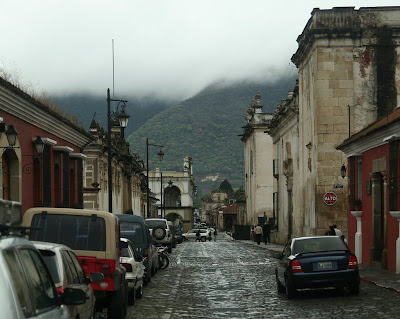
The city itself is charming: large blocks of two-story buildings, continuous so there are no alleyways, only pastel-colored walls with big wooden doors and windows with wrought-iron bars. Behind the blank facades of these establishments are homes, restaurants, inns, and other buildings that have a loose conception of inside-vs-outside. That is, most places are built around courtyards in the center or simply have open-air gardens or patios in the middle, without doors. So in Antigua the weather is always nice and there must be little or no bugs. And all the streets are wide and sloped towards the center so that the rainwater (it rained or was rainy the whole time we were there) runs in a small stream through the center of a street. The streets are made of irregularly-shaped stones, so that a car ride is very bumpy. A doctor told me that his English was “worse than the streets in Antigua.”

Speaking of the doctor, I have amoebas. This may have begun with my fit of vomiting etc. about two weeks ago. They don't hurt very much, but I'm now taking medicine that's supposed to flush them out. Derek and Valerie and most recently Erin M. are sick too, but I don't know what they officially “have” yet.

But that didn't stop me (although by the end it stopped Valerie) from splurging on all the good food they've got: curry, chicken enchiladas, some great soups, nice pizza (a good break from beans and eggs and corn tortillas), and a great dessert cafe with strong coffee.

There was one gigantic tourist store called Nim Pot with some really bizarre stuff: creatures and monsters made of wood and bizarre colors, masks, two Jesus chairs (as if you were sitting in his lap), a gigantic wooden “giraffe,” spurs, wooden saints and other figurines. But the most bizarre of all was a wall of small wooden paintings with handwriting underneath them (like Far Side comics, but the paintings weren't as good) that quite graphically depicted terrible things: sinking ships, disease, adultery, murder, the September 11 attacks, women giving birth on floors, and acts of sodomy. In the sky overlooking all the madness are either an angels or Christ on the cross. The writing underneath expresses some kind of prayer request or thanks, such as I thank God that I was able to see my wife cheating on me or I thank God that my attackers didn't know that I had AIDS.


One of the two organized events we did while there was to wake up at 5:30 and climb Vulcan Picaya, a pretty cool experience. The climb to the volcano took us by some farms and through dense woodland until suddenly the forest stopped just shy of the top of a knoll. We climbed it and gazed at the mist that surrounded our vantage point: it reminded me of the Scottish highlands or something. Then, suddenly, a strong wind dispersed the mist to reveal a huge field of black lava in front of us. Our guide headed in this direction.

Walking on lava is bizarre. You're basically walking/climbing over piles of medium-sized black rocks, with the occasional fissure to your left or right and then a stream of molten lava. It got pretty hot, but with the cool weather, it wasn't too bad. A couple pairs of shoes melted though. The rocks sound hollow but are heavy and jagged and sharp: I cut my hand when some rocks under me shifted and I had to catch myself. It began to rain a little, and the ground under us roared and steamed. We weren't even on the real volcano, just a smaller mountain off to its side.

But yeah, it was once again great to spend time with “classmates” (friends) in a city conducive to spending time with people: good food, good coffee, good live music. I could write a paragraph about each person in the program, but Zach deserves a shout-out for going back out with me one night and helping me find my knife after it fell out of my pocket while we were racing somewhere (which was his idea anyway), a painstaking task in the dark streets and the thousands of rocks with knife-sized gaps in between them.

Darja said that we might have worse culture shock coming back from Antigua than from the beginning of the program. That's definitely an exaggeration for me and probably for most of us, but we definitely lived it up over there.


a local or a tourist? Who knows in Antigua


our hotel


Dr Wallace holding what will be used for our (the sick ones) stool samples.


We decided this Cathedral would be a perfect place for a family photo. Clockwise from top L: Nicole, Zach, Erin R, Me, Darja, Andrea, Mary Beth


Centro de Investigaciones Regionales de Centroamerica (“Investigaciones” means Research), where Allie's aunt works (that's her talking). The Centro is basically a big database of Guatemalan history, with libraries of old books, maps, newspapers, and photos. They've done a respectable job too: while many similar institutions were suspected of being on one side or the other and thus forced to close during the Civil War, this one remained open, a testament to its neutrality.


Catedral de Santiago


Remember how I wrote about Maximon, the guy who's in the photo in between the two photos of Jesus on Catarina's dresser? Well apparently one of the guys he's supposed to represent, conquistador Pedro de Alvarado, was buried under the altar in this Cathedral.


Zach Climbing on Ruins


Picaya


photo by Derek Stemple


me climbing on ruins. Photo by Nicole Azpelliga